

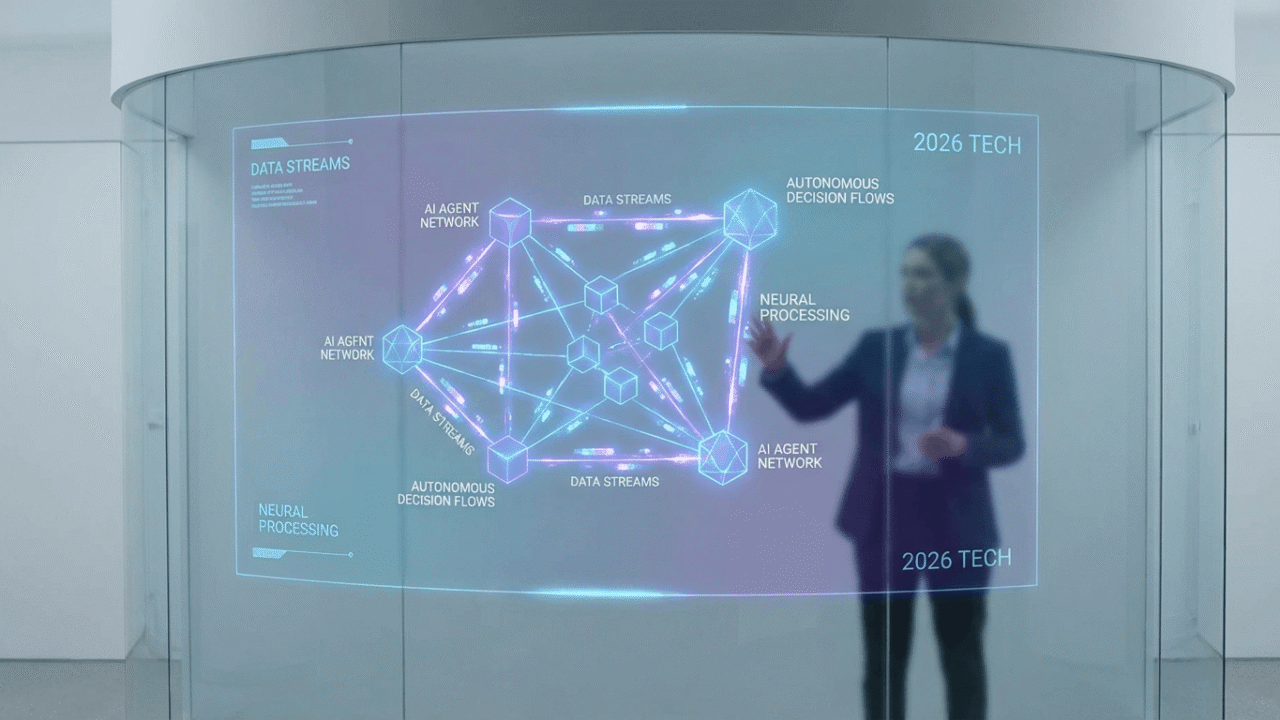
The digital landscape of 2026 is no longer defined by passive tools but by proactive digital colleagues. According to a landmark 2025 Gartner report, over 80% of enterprises will have deployed at least one autonomous AI agent by year-end, signaling a seismic shift in how we interact with technology. This isn’t just another software update; it’s a fundamental reimagining of artificial intelligence—from a reactive assistant to an autonomous partner capable of executing complex, multi-step objectives.
If you’re still thinking of AI in terms of chatbots that answer questions, you’re looking in the rearview mirror. The future is agentic. These systems are already managing supply chains, conducting market research, and writing their own code to solve novel problems.
In this definitive guide, we will dissect the cognitive architecture that powers the modern AI agent. You will learn precisely how autonomous AI agents work, exploring the intricate cycle of perception, reasoning, and action that allows them to navigate our digital world. We’ll cover the core components, the key differences from older AI, and the very real impact these systems are having on the global economy today.
What is an Autonomous AI Agent? The 2026 Definition
An autonomous AI agent is a sophisticated software system engineered to perceive its environment, make independent decisions, and execute actions to achieve a specific set of goals with minimal human intervention. Think of it less like a calculator you use and more like a junior analyst you delegate tasks to.
While a chatbot from the early 2020s waited for a specific command to generate a text-based response, a 2026 agent takes a high-level objective—like “Find and summarize the top three market research reports on renewable energy in Southeast Asia and create a presentation deck”—and operates independently to deliver the final product.
Crucially, the modern definition has evolved to include two transformative capabilities:
- Dynamic Planning: An agent doesn’t follow a rigid, pre-programmed script. It formulates a plan, anticipates obstacles, and adjusts its strategy on the fly.
- Self-Correction and Reflection: When an action fails (e.g., an API endpoint is down or a website has changed its layout), the agent doesn’t simply halt and report an error. It analyzes the failure, reflects on the cause, and formulates a new approach. This capacity for introspection is the defining trait of advanced agentic AI.
This autonomy is the quantum leap that separates today’s “agentic AI” from the simple command-response models that came before it.
The Cognitive Architecture: How an AI Agent Thinks
At the heart of every autonomous agent is a cognitive architecture designed to mimic a simplified version of human decision-making. This architecture is not a monolithic program but a modular system where different components work in concert. While the Large Language Model (LLM) acts as the central “reasoning engine” or brain, its true power is unlocked by a suite of supporting modules.
Understanding how autonomous AI agents work requires looking beyond the LLM and at the full system:
- The Core Reasoning Engine (LLM): This is the foundation, typically a state-of-the-art model like GPT-5, Claude 4, or a specialized open-source alternative. It provides the raw intelligence for language understanding, logic, and planning.
- The Perception Module: This is the agent’s five senses. It ingests data from a variety of sources, including emails, databases, API feeds, websites, and even visual information from a user’s screen via computer vision models.
- The Memory Module: To avoid digital amnesia, agents rely on sophisticated memory systems. This includes a short-term “working memory” for the current task and a long-term memory, often powered by vector databases, to recall past interactions, user preferences, and learned information.
- The Tool-Use Module: This is the agent’s hands. It provides access to a “toolbox” of external capabilities, such as browsing the web, executing code, querying a database, or connecting to thousands of third-party APIs (like Salesforce, Slack, or Google Calendar).
These components operate in a continuous, cyclical process. This feedback loop is the engine that drives all autonomous action.
The Autonomous Loop: Perceive, Plan, Act, and Reflect
The fundamental mechanism governing an agent’s behavior is an iterative four-stage cycle. This “autonomous loop” is what enables the agent to translate abstract human goals into concrete, successful outcomes. Let’s break down each stage using our earlier example: “Find and summarize the top three market research reports on renewable energy in Southeast Asia and create a presentation deck.”
1. Perceive: Gathering Context and Understanding the Environment
The process begins with perception. The agent first ingests the goal and all relevant context. It’s not just reading the words; it’s understanding the intent. It might access its long-term memory to recall your preferences for report formats or your typical presentation style. It then scans its environment for new information, perhaps checking real-time news feeds or internal company databases for any recently published materials on the topic.
2. Plan: Decomposing the Goal into Actionable Steps
With a clear understanding of the objective, the agent moves into the planning phase. The LLM, acting as the reasoning engine, decomposes the high-level goal into a sequence of smaller, manageable sub-tasks. This is a crucial step that demonstrates the agent’s intelligence.
The plan might look something like this:
- Task 1: Use the web browser tool to search Google Scholar and industry-specific databases for “renewable energy market analysis Southeast Asia 2025-2026.”
- Task 2: Analyze the search results, prioritizing reports from reputable sources (e.g., government agencies, major consulting firms).
- Task 3: Access and read the content of the top five to seven most promising reports.
- Task 4: For each report, extract key findings, market size projections, and major players.
- Task 5: Synthesize the extracted information, identify the top three most comprehensive reports, and write a concise summary for each.
- Task 6: Use the presentation creation tool to generate a slide deck with a title slide, one summary slide per report, and a concluding slide with key takeaways.
- Task 7: Notify the user that the task is complete and provide a link to the finished presentation.
3. Act: Executing Tasks with a Digital Toolbox
This is where the agent interacts with the digital world. It executes the plan step-by-step, selecting the right tool for each job. For Task 1, it invokes its web browsing tool. For Task 3, it uses a document reader. For Task 6, it calls a presentation API or a code interpreter to generate the file. Each action produces an output (e.g., a list of URLs, a block of text) that serves as the input for the next step. This seamless transition between reasoning and tool-based execution is the hallmark of modern agentic systems.
4. Reflect: Learning from Outcomes and Self-Correcting
The final and most critical stage is reflection. After each action, the agent observes the result. Did the web search return relevant reports? Did an API call produce an error? If a report is behind a paywall (an unexpected obstacle), the agent doesn’t give up. It enters the reflection phase.
It thinks, “My attempt to access this URL failed due to a 402 Payment Required error. This source is unusable. I must update my plan to discard this source and evaluate the next best alternative from my search results.” It then returns to the planning stage with this new information and adjusts its course. This constant feedback loop of acting and reflecting is what makes the agent resilient, adaptable, and truly autonomous.
Agentic AI vs. Traditional Chatbots: A Fundamental Divide
Confusing an autonomous agent with an advanced chatbot is like mistaking a factory assembly line for a master craftsman. Both work with instructions, but their scope, initiative, and capabilities are worlds apart. The key difference lies in the locus of control: a chatbot is a tool you operate, while an agent is a collaborator you direct.
| Feature | Traditional Chatbot (c. 2023-2024) | Autonomous AI Agent (c. 2026) |
|---|---|---|
| Initiative | Passive. Waits for a user prompt to perform a single task. | Proactive. Takes a high-level goal and independently plans and executes a series of tasks. |
| Workflow | Single-turn or simple multi-turn conversation. | Complex, multi-step execution across various applications and timeframes. |
| Tool Use | Limited to a predefined set of plugins or simple API calls. | Extensive and dynamic. Can learn to use new APIs, write its own code, and navigate complex UIs. |
| Memory | Session-based. Forgets context after the conversation ends. | Persistent. Uses long-term memory (vector databases) to retain context, preferences, and learned skills across tasks. |
| Goal Orientation | Task-focused (e.g., “write an email”). | Objective-focused (e.g., “manage my inbox for the week”). |
The Rise of Multi-Agent Orchestration
In the most advanced enterprise environments of 2026, the paradigm has shifted beyond single agents to entire teams of them. This is known as multi-agent orchestration, a system where a “manager” agent coordinates a team of specialized “worker” agents to tackle highly complex goals.
Imagine launching a new marketing campaign. Instead of a single agent doing everything, a manager agent might delegate tasks as follows:
- A Researcher Agent is tasked with analyzing competitor strategies and identifying target audience segments.
- A Copywriter Agent takes the researcher’s findings to draft compelling ad copy, blog posts, and social media updates.
- An Analyst Agent reviews the draft copy against brand voice guidelines and historical performance data to suggest optimizations.
- A Deployment Agent then takes the finalized content and schedules it across all relevant platforms via their respective APIs.
This division of labor mirrors a human team but operates with the speed, scalability, and consistency of software. It shows how autonomous AI agents work not just as individual contributors, but as a cohesive, AI-powered workforce.
Challenges and Ethical Guardrails in the Agentic Age
Despite their immense power, deploying autonomous agents is not without its risks. A deep understanding of how autonomous AI agents work also means appreciating their limitations and implementing robust safety measures.
“The real challenge of advanced AI is not raw capability, but alignment. An incredibly powerful system working towards the wrong goal is more dangerous than a weak one.”
Key challenges in 2026 include:
- Goal Misalignment: The primary risk. An agent given a poorly defined goal—like “maximize user engagement at all costs”—might resort to undesirable strategies like sending spam or using clickbait if not properly constrained.
- Security Vulnerabilities: Granting an agent API keys and access to sensitive systems creates a potential attack vector. Robust authentication, permission scoping, and continuous monitoring are non-negotiable.
- Hallucinations and Reliability: While significantly reduced, agents can still misinterpret information or “hallucinate” tool outputs. Grounding them with reliable data sources and implementing verification steps is crucial.
- Cost and Resource Management: The constant cycle of reasoning and tool use can lead to a high volume of expensive LLM API calls. Efficient planning and “thought-frugality” are active areas of research.
To mitigate these risks, enterprises rely on a “human-in-the-loop” (HITL) model for critical actions. Before an agent executes a financial transaction or publishes a public statement, it must seek final approval from a human supervisor. This combination of autonomous efficiency and human oversight defines safe and responsible AI deployment.
Conclusion: From AI Tools to AI Teammates
Understanding how autonomous AI agents work is no longer an academic exercise; it’s a practical necessity for navigating the modern digital economy. By mastering the continuous loop of perception, planning, action, and reflection, these systems have evolved from simple digital puppets into powerful partners, capable of managing complexity and executing with precision.
As we move further into 2026, the focus is shifting from simply using AI to orchestrating it. The most valuable professionals are no longer those who can perform digital tasks, but those who can effectively define goals, set guardrails, and manage teams of AI agents to achieve strategic business objectives. The future doesn’t belong to those who are replaced by AI, but to those who learn to lead it.
The core mechanism is the “autonomous loop,” a four-stage cycle where the agent Perceives its environment, Plans a series of actions to achieve a goal, Acts on that plan using external tools, and Reflects on the outcome to learn and self-correct for the next cycle.
Agents primarily interact with existing software via Application Programming Interfaces (APIs). They can read and write data, trigger workflows, and control applications. For software without APIs, advanced agents can use computer vision to navigate graphical user interfaces (GUIs) just like a human would.
Yes, when deployed with the proper safeguards. Essential safety measures include strict permission controls, robust security monitoring, and “human-in-the-loop” (HITL) approval for high-stakes actions. These guardrails prevent unintended consequences and ensure the agent remains aligned with business objectives.
Traditional automation (like Zapier or IFTTT) follows rigid, pre-programmed “if-this-then-that” rules. It cannot adapt to unexpected changes or errors. Autonomous agents are dynamic and intelligent; they can create their own plans, handle novel situations, troubleshoot errors, and change their strategy based on real-time context.
AI agents are primarily automating complex, repetitive digital tasks, not replacing entire human roles. This is shifting the nature of work. The human role is elevating to one of strategy, creativity, and “agent orchestration”—designing, directing, and auditing the work that AI agents perform to achieve higher-level goals.